A groundbreaking Barbados-based renewable energy project took centre stage at the 25th United Nations (UN) Open-ended Informal Consultative Process on Oceans and the Law of the Sea (ICP), held in New York from June 16 to 20.
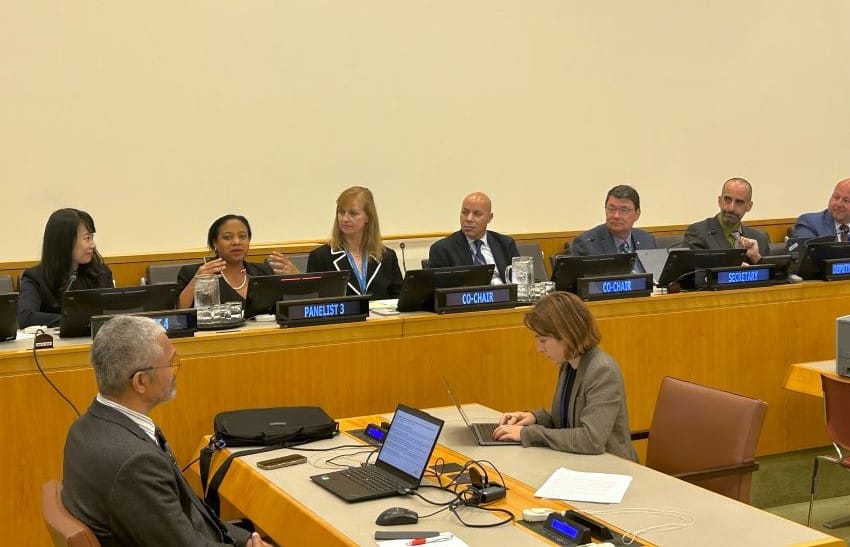
At the UN ICP meeting, co-chaired by Barbados’ Permanent Representative to the UN, François Jackman, and Ambassador and Permanent Representative of Iceland to the UN, Anna Jóhannsdóttir, Chief Executive Officer (CEO) and Founder of the Rum and Sargassum Company, Dr. Legena Henry, made a presentation on the energy project.
Dr. Henry explained that in 2019, an Inter-American Development Bank-funded summer research project at The University of the West Indies (UWI) Cave Hill Campus in Barbados explored whether ocean-derived Sargassum seaweed and rum distillery wastewater could co-digest in a biogas system.
She said this marked the origin of Rum and Sargassum Inc., a UWI spin-off clean technology start-up dedicated to converting waste into renewable fuel.
Dr. Henry reported that in the four years following its inception, the project progressed through laboratory trials, scaled up to pilot digesters, and procured a prototype fuelling station in Barbados. By 2024, it achieved a key milestone – Test Drive Zero – where an electric vehicle was powered by electricity generated from local biogas. With multiple technical validations, it reached TRL 5, yet remains pre-revenue due to the persistent funding gap for mid-stage clean tech.
The CEO also shared that in undertaking the project, systemic barriers were uncovered that disproportionately affect innovators from small island developing states, and that global funding tends to favour consultants over builders, and perception bias limits investment in solutions originating from the Caribbean.
She added that despite global media recognition and US-level technical expertise, structural and legal vulnerabilities persist. She called for more inclusive investment frameworks, stronger IP protections, and recognition of the global relevance of locally grown technologies.
This year’s UN Consultative process, under the theme “Capacity Building and the Transfer of Marine Technology: New Developments, Approaches and Challenges”, focused on capacity building in ocean matters.
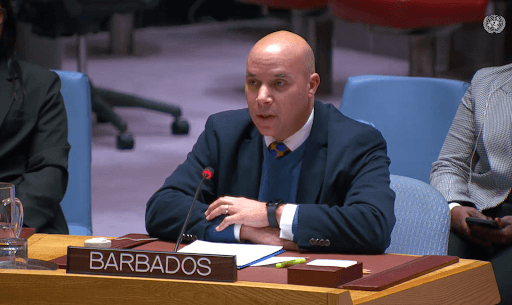
In his intervention during the meeting, Counsellor at the Barbados Permanent Mission to the United Nations in New York, Nicholas Cox, highlighted the importance of the economic and financial dimension of ocean governance: the blue economy.
He recommended that a future session of the process should be devoted to this issue, under the theme “Closing the Gap: Financing SDG 14 for Sustainable and Healthy Oceans”.
In 1999, the UN’s General Assembly decided to establish the United Nations Open-ended Informal Consultative Process on Oceans and the Law of the Sea, aimed at enhancing coordination and cooperation on ocean affairs and the law of the sea at the intergovernmental and inter-agency levels.
The session is an annual forum that facilitates the General Assembly’s review of ocean-related developments, and each year it focuses on specific themes identified by the General Assembly. It is the only universal forum where states can discuss emerging issues and set the agenda for future international action in the area of ocean governance.